Latest
Have you ever noticed? When we start a sentence in daily life with "I have a theory...", we are usually referring to a guess, or perhaps a fabricated idea. However, when a scientist puts on a lab coat and says, "We have a theory," what they mean carries a completely different weight.
Today, at here, we will dissect the critical difference between Theory and Theorem, perhaps the two most confused concepts in scientific literacy.
As a mathematician, I want to tackle one of the hottest debates of recent times: Can AI actually replace us?
To answer this question properly, we need to rewind the tape a bit and look at the dizzying evolution of AI over the last few years.
If you recall the early "hype" days of AI (I’m talking about the 2023 GPT here), the picture was pretty clear: AI was failing math class. I remember those days vividly; especially in abstract topics requiring high-level reasoning like probability, the model would basically talk nonsense. It struggled to even perceive matrices in my linear algebra questions and mixed up simple calculations. Back then, sitting in front of the screen, I thought, "This technology will probably never reach the level of a mathematician."
But when we look at today, the landscape is completely different. There’s been a frighteningly serious improvement in just a few years. We don't even need to hand-write equations anymore; we can just upload photos to ask our questions. Introducing matrices to AI is now child's play. In my recent tests, I’ve seen that the old "confusion" is gone, and it gives much more consistent and sharp answers, especially in probability. I’m sure everyone is aware of this shift.
The Effective Way of Learning: The Feynman Technique
In this article, we will explain the Feynman learning technique, a learning method that will contribute to your studies. Basically, this technique is based on the saying: "If you can't explain it simply, you don't understand it well enough." As we can clearly understand from this quote, if we cannot explain something in its simplest, plainest form, it means we haven't understood that topic sufficiently.
The Architects of Reality: A Journey Through History’s Greatest Mathematical Minds 🧮
Mathematics is often called the universal language. It is the invisible framework that holds our reality together, from the spiral of a seashell to the algorithms that power the device you are reading this on right now.
But math didn't just appear out of nowhere. It was built, theorem by theorem, by brilliant minds who dared to think differently. From the dusty classrooms of Ancient Greece to the code-breaking rooms of World War II, these pioneers changed the course of history.
Here are the mathematical giants who shaped our world.
More to read
Hey friends, in this post, I’m going to pass on my experiences on how to study effectively. Let's be real studying isn't exactly a desired activity for most people; it feels more like torture. Of course, there are reasons for this, and in this post, we’re going to talk about those reasons and find some solutions. First off, I have to say this: it is totally normal to struggle to understand something. It’s normal to get bored when you don’t get it, and it’s normal to want to quit in those moments. But let’s get started.
What Is the Difference Between a Scientific Theory and a Mathematical Theorem?
Introduction:
People often confuse two crucial terms: scientific theory
and mathematical theorem. Phrases like “evolution is just a theory”
reveal a fundamental misunderstanding of what a theory actually means in
science. This article breaks down the key differences between theories
in science and theorems in mathematics, helping you understand how these
concepts operate in completely different domains.
The State of Higher Education Quality Worldwide: Challenges, Disparities, and the Path Forward
Introduction
Higher education plays a critical role in shaping the future of individuals, societies, and global economies. As the demand for skilled labor intensifies in an increasingly knowledge-driven world, universities are expected to deliver not only degrees but also quality education that equips students with critical thinking, innovation, and practical skills. However, the reality across different countries and institutions reveals stark disparities in the quality of higher education. This article provides an in-depth analysis of the current state of global university education quality, identifying key challenges, regional disparities, and strategic recommendations for improvement.
The Invisible Hand of Mathematics: How Math Shapes Our Daily Lives
When most people hear the word "mathematics," their minds instantly jump to school textbooks, endless equations, or high-level abstract concepts. But the reality is far more fascinating—and more integrated into our daily lives than we often realize. Mathematics is not just a subject; it's a silent framework that supports everything from our morning routines to the most complex systems in modern society. In this article, we'll explore how mathematics quietly governs the patterns, decisions, and, efficiencies of everyday life.
Why It’s Alarming When People Reject Science in Favor of Misinterpreting Religious Texts
Introduction: Science vs. Personal Beliefs
In an age of unprecedented scientific advancement, it is deeply concerning that many individuals continue to reject well-established scientific facts such as evolution, climate change, and the efficacy of vaccines. Instead, they often lean on personal interpretations of religious texts, choosing faith-based explanations over empirical evidence. While religion and science can coexist harmoniously, misusing religion to oppose science undermines public health, education, and our collective future.
This article explores why the denial of science in favor of misinterpreted religious beliefs is a serious issue, focusing on key scientific topics like evolution theory, global warming, and vaccination. It also proposes ways to bridge the gap between faith and reason in modern societies.
The Value of Scientific Truth in Modern Society
Science is built on evidence, experimentation, and peer review. It has provided us with groundbreaking discoveries, improved quality of life, and prolonged human lifespan. Without scientific thinking, we would not have access to antibiotics, smartphones, or clean energy solutions.
Rejecting scientific truths such as:
-
Evolution: The foundation of modern biology
-
Global Warming: A proven and accelerating threat to Earth’s climate
-
Vaccines: Lifesaving tools that protect us from infectious diseases
…is not just intellectually irresponsible—it’s dangerous.
When people deny these facts, it often stems not from true religious doctrine, but from selective or misinformed interpretations of sacred texts. This growing skepticism toward science, particularly in digital echo chambers, is not only anti-intellectual but harmful on a global scale.
Evolution and the Creationism Debate
The theory of evolution by natural selection, introduced by Charles Darwin, is supported by a vast amount of fossil evidence, genetic data, and observable biological processes. Yet, some individuals reject this theory, insisting that life on Earth was created exactly as described in religious texts, often taking those texts literally.
However, evolution and faith do not have to be at odds. Many religious scholars and scientists argue that spiritual beliefs can coexist with scientific explanations. Evolution can be viewed as the mechanism by which a divine being created life—not necessarily a contradiction, but a different lens through which to interpret nature.
Still, the resistance to teaching evolution in schools, particularly in conservative regions, limits students’ access to scientific literacy and undermines education.
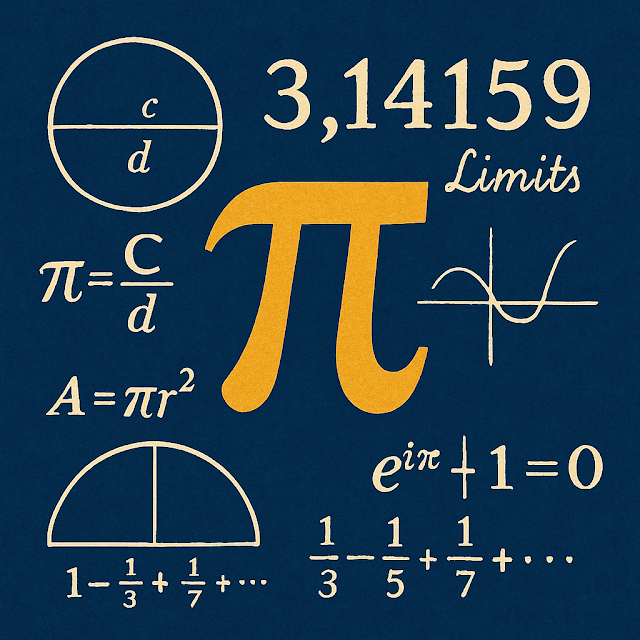
The Power of Pi: Why the World Still Circles Around This Mysterious Number
Introduction: More Than Just 3.14
Pi (π) – the seemingly simple number that starts with 3.14 – is far from ordinary. This irrational, non-repeating, and never-ending number has intrigued scholars for over 4,000 years. From ancient Egypt to modern computer algorithms, Pi is everywhere – in circles, spheres, sound waves, probability theory, and even art. But why is this one number so significant? And how has it maintained such a strong presence in both mathematics and popular culture?
In this blog post, we explore the origins, mathematical properties, real-world applications, and cultural impact of Pi. Whether you're a math enthusiast, a curious reader, or an SEO-focused blogger, this comprehensive guide will help you understand why Pi is so much more than a number.
The Birth of Mathematics in Ancient Greece: Through the Minds of Pythagoras, Euclid, and Archimedes
Introduction: The Cradle of Mathematical Thought
When we trace the roots of mathematics as we know it today, our journey inevitably takes us back to Ancient Greece—a civilization where reason was revered, logic was celebrated, and the mysteries of the universe were pursued through numbers and geometry. While earlier civilizations like the Babylonians and Egyptians contributed practical methods, it was in Greece that mathematics took on a theoretical and philosophical dimension. This transformation was driven by the groundbreaking work of three intellectual giants: Pythagoras, Euclid, and Archimedes.
In this article, we explore how these ancient thinkers shaped the foundation of modern mathematics, delving into their key discoveries, their philosophical insights, and the enduring legacy they left behind. Whether you're a math enthusiast, a history lover, or a curious learner, this deep dive into the origins of mathematics in Ancient Greece reveals how timeless ideas born over two millennia ago still guide scientific and mathematical reasoning today.
René Descartes: The Father of Modern Philosophy and the Pioneer of Analytical Geometry
Introduction
René Descartes, a towering figure in both philosophy and mathematics, is often hailed as the father of modern philosophy. His work laid the foundations for many intellectual movements that shaped the Enlightenment and the scientific revolution. Known for the famous dictum "Cogito, ergo sum" (I think, therefore I am), Descartes reshaped the way humans perceive knowledge, truth, and the very act of thinking. In the realm of mathematics, his invention of the Cartesian coordinate system revolutionized geometry by merging it with algebra. This article explores the life of René Descartes, delves into his contributions to mathematics and philosophy, and highlights the enduring impact of his ideas.
Leonhard Euler: The Mathematical Genius Who Shaped the Modern World
Leonhard Euler (1707–1783) is one of the most prolific and influential mathematicians in history. Born in Basel, Switzerland, Euler revolutionized a wide range of fields including mathematics, physics, astronomy, and engineering. His contributions laid the foundation for much of modern mathematics, and many concepts and notations still in use today can be traced back to him. Despite losing his eyesight later in life, Euler continued to produce groundbreaking work, dictating volumes of content with unwavering intellectual precision. His story is not only one of genius but also of resilience, passion, and relentless curiosity.